Why Are Health Insurance Deductibles So High in the U.S.?
Why are health insurance deductibles so high in the United States, even as premiums continue to rise?
Why do so many Americans pay thousands of dollars every year for health insurance, only to face $7,000 to $9,000 deductibles before meaningful coverage begins?
These questions are not theoretical. They reflect the lived experience of millions of middle-class Americans who feel insured on paper but financially exposed in practice.
If you’ve ever asked:
-
“Is a $7,000 deductible health plan normal?”
-
“Why am I paying for insurance I can’t afford to use?”
-
“Why does health insurance feel useless until something catastrophic happens?”
—you’re not alone.
Affiliate Disclosure: This article may contain affiliate links. If you click and take action, we may earn a commission at no additional cost to you. This content is educational and does not provide medical or insurance advice.
This article explains, in plain terms, why deductibles are so high, how this system developed, who it benefits, and why the middle class feels squeezed the hardest. This is not an attack on insurance—it’s an explanation of incentives, economics, and consequences.
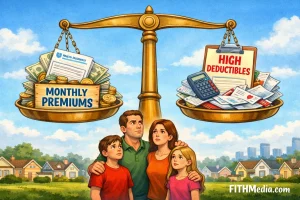
What a Health Insurance Deductible Really Is (And What It Isn’t)
A deductible is the amount you must pay out of pocket for covered healthcare services before your insurance starts paying its share.
What many people misunderstand is this:
A deductible is not the most you’ll pay.
It’s just the entry fee before insurance meaningfully helps.
Most plans still require:
-
Copays
-
Coinsurance
-
Separate deductibles for individuals vs families
This means high deductibles often represent only the first layer of financial responsibility, not the last.
When Did High Deductibles Become the Norm?
High deductibles didn’t always dominate U.S. health insurance.
What Changed
Over the past two decades:
-
Healthcare costs rose faster than wages
-
Employers shifted more costs to employees
-
Insurers redesigned plans to limit early payouts
High deductible health plans (HDHPs) were introduced as a way to:
-
Lower monthly premiums
-
Reduce unnecessary utilization
-
Encourage “consumer responsibility”
In theory, consumers would shop for care like any other service.
In reality, healthcare doesn’t behave like a normal market.
Why Insurance Companies Favor High Deductibles
From an insurer’s perspective, high deductibles are efficient.
High Deductibles Help Insurers By:
-
Reducing small, frequent claims
-
Lowering administrative costs
-
Discouraging low-value care usage
-
Shifting first-dollar risk to consumers
When fewer people submit claims, insurers:
-
Spend less processing paperwork
-
Pay out less overall
-
Maintain profitability even as premiums rise
This doesn’t mean insurers are malicious—but it does mean their incentives are not aligned with early, affordable access to care.
Why Employers Accept High Deductibles
Employers play a major role in deductible inflation.
Many employers face:
-
Rising group health plan costs
-
Pressure to control benefit expenses
-
Limited ability to raise wages
High deductible plans allow employers to:
-
Offer “coverage” without absorbing full cost increases
-
Keep benefit line items manageable
-
Shift cost responsibility to employees
The result?
Employees technically have insurance—but face more financial risk when they actually use it.
Why the Middle Class Is Hit the Hardest
Low-income households may qualify for:
-
Subsidies
-
Public programs
-
Reduced cost-sharing
High-income households can:
-
Absorb deductibles
-
Self-insure smaller risks
-
Use savings without crisis
The middle class often has:
-
Too much income for subsidies
-
Too little liquidity for high deductibles
-
Rising fixed expenses (housing, childcare, debt)
This is why searches like “middle class health insurance struggles USA” are exploding.
Is a $7,000–$9,000 Deductible Health Plan Normal?
Yes. Unfortunately, it is increasingly common.
Many individual and family plans now feature:
-
$6,000–$9,000 individual deductibles
-
$12,000–$18,000 family deductibles
These numbers are not extreme outliers. They are mainstream.
For many households, this deductible represents:
-
Multiple months of rent
-
Most of their emergency savings
-
A serious financial shock
Which raises the question:
If a deductible is financially devastating, does the plan truly provide access to care?
Why Premiums Are Still High Even With High Deductibles
A common misconception:
“If my deductible is high, my premium should be low.”
In practice:
-
Premiums cover shared risk across the pool
-
Deductibles limit early payouts
-
Both exist simultaneously
Premiums are influenced by:
-
Average expected claims
-
Administrative costs
-
Network pricing
-
Regulatory requirements
High deductibles don’t eliminate risk—they reallocate it.
Why Paying the Deductible Still Doesn’t Mean “Free Care”
Even after meeting your deductible, you may still owe:
-
20%–40% coinsurance
-
Copays for certain services
-
Separate drug deductibles
This creates a layered system where:
-
Financial stress peaks early
-
Relief comes later (if at all)
This is why many people say:
“I met my deductible and still got a bill.”
They’re not wrong.
The Psychological Impact of High Deductibles
High deductibles change behavior.
People begin to:
-
Delay doctor visits
-
Skip tests
-
Avoid follow-ups
-
Negotiate cash prices
This is not irresponsibility—it’s risk management under financial pressure.
But delayed care often:
-
Increases long-term costs
-
Worsens health outcomes
-
Leads to emergency situations
Ironically, high deductibles can increase system-wide costs while saving insurers money in the short term.
Why Health Insurance Deductibles Feel Punitive
Deductibles feel punitive because:
-
They hit hardest when you’re sick
-
They arrive unpredictably
-
They require large lump sums
Unlike premiums (predictable monthly costs), deductibles:
-
Strike during moments of vulnerability
-
Are difficult to budget around
-
Create fear around seeking care
This is why many people describe health insurance as financial stress disguised as protection.
High Deductibles vs Preventive Care (The Confusing Exception)
Most plans cover preventive care outside the deductible:
-
Annual checkups
-
Screenings
-
Vaccinations
This creates confusion:
-
Preventive visits are “free”
-
Diagnostic visits are expensive
Patients often don’t realize when care switches from preventive to diagnostic—until the bill arrives.
Why Transparency Hasn’t Fixed the Problem
Price transparency was meant to help consumers shop.
But healthcare pricing is:
-
Fragmented
-
Complex
-
Inconsistent across providers
You often don’t know:
-
Final cost
-
Insurance adjustment
-
Coinsurance amount
until weeks after the service.
High deductibles + low transparency = financial anxiety.
Who High Deductible Health Plans Actually Work For
They work best for:
-
High earners with strong savings
-
People with minimal healthcare needs
-
Those comfortable managing financial risk
They work poorly for:
-
Families
-
People with chronic conditions
-
Anyone living close to the margin
This mismatch fuels frustration—not ignorance.
How This Connects to the “Fear Tax” Feeling
When deductibles are:
-
High
-
Unpredictable
-
Hard to plan for
People buy insurance mainly to avoid disaster, not to enable care.
That’s why deductibles are central to the idea that health insurance feels like a fear tax.
How to Survive High Health Insurance Deductibles (Without Gambling Your Health)
Once you accept that high health insurance deductibles are now normal in the U.S., the next question becomes practical:
How do you live with them without delaying care, going into debt, or feeling constant financial fear?
The key is shifting from hope-based coverage to strategy-based coverage.
Below are actionable steps middle-class Americans use to reduce the damage caused by high deductibles.
Actionable Insight #1: Treat the Deductible Like a Real Bill (Not a Hypothetical)
One of the biggest mistakes people make is pretending the deductible doesn’t exist—until it suddenly does.
If your deductible is:
-
$6,500
-
$7,500
-
$9,000
That is not theoretical exposure. It is a real potential bill.
What to Do Instead
-
Write the deductible amount down
-
Compare it to your savings
-
Ask: Could I pay this in the next 90 days if needed?
If the answer is no, your plan is financially risky, even if the monthly premium feels affordable.
Actionable Insight #2: Build a “Deductible Buffer,” Not a Generic Emergency Fund
A deductible-specific buffer reduces fear dramatically.
How to Build It
-
Open a separate savings pocket
-
Automate small, consistent transfers
-
Treat it as “untouchable except for medical care”
You don’t need the full deductible immediately.
Even 30–50% coverage:
-
Changes decision-making
-
Reduces care avoidance
-
Lowers stress
This turns health insurance from fear-based to preparedness-based.
Actionable Insight #3: Understand Which Services Bypass the Deductible
Many Americans overpay simply because they don’t know what’s covered before the deductible.
Often covered outside the deductible:
-
Preventive care
-
Annual checkups
-
Screenings
-
Certain vaccines
Often not covered:
-
Diagnostic visits
-
Imaging
-
Specialist consultations
Why This Matters
Knowing the boundary prevents surprise bills and helps you time care intelligently.
Actionable Insight #4: Ask for the “Allowed Amount” Before Scheduling Care
High deductibles hurt more when pricing is unclear.
Before non-emergency care, ask:
-
“What is the allowed amount for my insurance plan?”
-
“What would I owe before meeting my deductible?”
-
“Is there a cash-pay discount?”
This simple question often reveals:
-
Huge price differences between providers
-
Situations where cash is cheaper than insured pricing
Transparency doesn’t fix the system—but it reduces shock.
Actionable Insight #5: Choose Plans Based on Income Stability, Not Just Premiums
High deductible health plans assume stable income.
If your income is:
-
Variable
-
Seasonal
-
Freelance
-
Commission-based
High deductibles are far more dangerous.
Rule of Thumb
-
Stable income → higher deductible tolerance
-
Unstable income → lower deductible preference
This explains why self-employed health insurance high deductible plans cause disproportionate stress.
Actionable Insight #6: Separate Routine Care From Catastrophic Risk
Insurance is best at protecting against large, unpredictable events.
It is weaker at covering:
-
Routine visits
-
Predictable care
-
Ongoing minor needs
Smart consumers:
-
Use insurance for disasters
-
Manage routine care strategically
-
Budget instead of guessing
This mental shift reduces frustration.
Actionable Insight #7: Avoid “False Upgrades” When Choosing Plans
Lower deductibles often come with:
-
Much higher premiums
-
Long-term cash flow pressure
Sometimes the “better” plan:
-
Costs more annually
-
Provides psychological comfort
-
Doesn’t reduce total spending
Always compare:
Premium + expected usage, not deductible alone.
Case Study #1: The Middle-Class Family With a $14,000 Family Deductible
Profile
-
Two working parents
-
Household income: $92,000
-
Family deductible: $14,000
-
Monthly premium: $780
What Happens
-
Child needs imaging
-
Cost before deductible: $1,600
-
Insurance discount applies
-
Family still owes $1,100
Outcome
They delay further care—not due to irresponsibility, but cash flow reality.
Lesson
A deductible larger than emergency savings creates avoidance behavior.
Case Study #2: Single Professional With a $7,500 Deductible
Profile
-
Age 33
-
Income: $70,000
-
Deductible: $7,500
-
Uses insurance once per year
What Happens
-
Skips therapy
-
Avoids diagnostics
-
Pays premiums purely for catastrophe protection
Lesson
This plan functions as disaster insurance, not healthcare access.
Case Study #3: Self-Employed Consultant With Variable Income
Profile
-
Income range: $55k–$90k
-
Deductible: $8,500
-
No employer contribution
What Happens
-
Uses cash-pay clinics
-
Keeps insurance only for worst-case scenarios
-
Constant anxiety about unexpected bills
Lesson
High deductibles punish income volatility more than low income.
Case Study #4: Chronic Care Household That Always Meets the Deductible
Profile
-
One chronic condition
-
Deductible met every year
What Happens
-
Insurance eventually helps
-
But only after heavy early-year spending
-
Financial stress peaks before benefits kick in
Lesson
High deductibles front-load pain—even when coverage eventually works.
Why High Deductibles Increase Fear, Not Responsibility
High deductibles are often justified as encouraging “smart consumer behavior.”
In reality, they:
-
Encourage care avoidance
-
Penalize illness timing
-
Increase financial stress during vulnerability
This is why health insurance deductibles feel punitive, not empowering.
Why This System Persists Despite Public Frustration
High deductibles persist because:
-
They reduce insurer payouts
-
They stabilize premiums (relatively)
-
They shift risk quietly to consumers
Until incentives change, deductibles will remain high—especially for the middle class.
How This Connects Back to the “Fear Tax” Concept
When people:
-
Can’t afford deductibles
-
Don’t trust coverage
-
Fear surprise bills
Insurance becomes something they pay for emotionally, not something they use confidently.
That’s the essence of the fear tax feeling.
Quick Recap
In the beginning, we built the foundation: what mortgages are, how borrowing works, and how to choose a mortgage path without getting overwhelmed. We also introduced the strategy behind using smart U.S. low-competition long-tail mortgage keywords to match real search intent.
Mid way, we went deep into actionable insights and case studies—showing how different borrowers (first-time buyers, low down payment buyers, self-employed, credit-rebuilders, refinance shoppers) should think about rates, fees, timing, and lender comparisons.
Frequently Asked Questions (FAQs)
1) What is the “best” mortgage type in the U.S. right now?
There isn’t one “best” mortgage for everyone—only the best match for your budget stability, timeline, and risk tolerance.
A mortgage type can look great on paper and still be wrong for you if:
-
your income is unpredictable,
-
you may move soon,
-
you can’t handle payment swings,
-
or you don’t have savings for surprises.
A safer way to decide is to ask:
-
Do I want a predictable payment (fixed-rate)?
-
Do I need a lower payment now (adjustable-rate might look tempting, but has risk)?
-
Am I buying for the long term (usually favors stability)?
-
Do I need flexibility (extra payments, no penalties, refinance options)?
Practical rule: If you value stability and don’t want rate surprises, fixed-rate mortgages are easier to live with. If you know you’ll move soon and can handle uncertainty, an adjustable-rate option may be considered—but only after you understand the worst-case payment.
2) How much down payment do I need for a house?
Down payment requirements vary widely by loan program and lender. Many buyers assume they “need 20%,” but that’s not always true.
However, lower down payments can create trade-offs:
-
higher monthly payments,
-
added insurance costs,
-
stricter underwriting,
-
or larger cash requirements later.
Better question: “How much down payment makes my monthly payment safe?”
Because you can be approved and still be “house-poor.”
Practical tip: Run your payment with multiple down payment levels (example: 3%, 5%, 10%, 20%) and compare:
-
monthly payment,
-
total cash needed,
-
and how much cushion you keep after closing.
If your down payment empties your emergency fund, that’s a risk—even if the deal looks good.
3) What credit score do I need to qualify for a mortgage?
There isn’t a universal minimum score. Different lenders and loan programs have different standards, and your full profile matters:
-
income,
-
debt-to-income ratio,
-
savings,
-
job stability,
-
and credit history details.
Instead of chasing one “magic” score, focus on what moves approvals and pricing:
-
consistent on-time payments,
-
low credit utilization,
-
clean recent history,
-
fewer new accounts right before applying.
Practical tip: If you’re within 60–90 days of applying, don’t do anything dramatic unless a professional advises it. Sudden moves (opening accounts, closing lines, large debt changes) can cause surprises.
4) How long does mortgage pre-approval take?
Some pre-approvals can happen quickly (even same day), but the true timeline depends on how ready your documents are.
Common items that speed it up:
-
stable income documents,
-
clean bank statements,
-
consistent employment history,
-
and straightforward debts.
Common items that slow it down:
-
self-employment with complex income,
-
recent job changes,
-
undocumented deposits,
-
credit disputes in progress,
-
or missing paperwork.
Practical tip: Build a “mortgage document folder” before applying:
-
ID
-
pay stubs (if employed)
-
tax returns (especially for self-employed)
-
bank statements
-
proof of additional income (if any)
-
list of debts and monthly obligations
Being organized reduces stress and improves lender confidence.
5) Does getting pre-qualified guarantee I’ll be approved?
No. Pre-qualification is often a lighter review. Pre-approval is generally stronger, but even pre-approval isn’t a final guarantee.
Final approval depends on:
-
the full underwriting process,
-
verification of your financials,
-
the property appraisal,
-
and final checks near closing.
Practical tip: Don’t make big financial moves after pre-approval:
-
don’t buy a car,
-
don’t open credit cards,
-
don’t take on new payment plans,
-
don’t change jobs if you can avoid it.
This is one of the most common ways buyers unintentionally derail closings.
6) What is the biggest mistake first-time homebuyers make?
One of the biggest mistakes is focusing only on the home price, not the total monthly cost.
Your monthly housing cost can include:
-
principal + interest
-
property taxes
-
homeowners insurance
-
mortgage insurance (if applicable)
-
HOA fees (if applicable)
-
maintenance and repairs
-
utilities (which may be higher than expected)
Practical tip: Make a “real monthly housing budget” before shopping:
-
Estimate taxes and insurance conservatively.
-
Include HOA if the neighborhood has one.
-
Add a monthly maintenance buffer (even new homes have issues).
If your budget works only when “nothing goes wrong,” it’s too tight.
7) Is it better to rent or buy in the U.S. right now?
It depends on your timeline and stability, not just market headlines.
Buying may make more sense if:
-
you plan to stay long enough to justify closing costs,
-
your income is stable,
-
you have savings beyond the down payment,
-
and your monthly payment is manageable.
Renting may make more sense if:
-
you might move soon,
-
your income is uncertain,
-
you’re still rebuilding credit,
-
or your cash reserves are thin.
Practical tip: Use a “3-question test”:
-
Can I stay at least several years?
-
Can I afford the payment comfortably?
-
Will I still have emergency savings after closing?
If any answer is “no,” renting can be the smarter temporary decision.
8) What is “debt-to-income ratio,” and why does it matter so much?
Debt-to-income (DTI) ratio compares your monthly debt payments to your monthly income. Lenders use it to judge how safely you can handle a new mortgage payment.
DTI includes things like:
-
car loans,
-
student loans,
-
credit card minimums,
-
personal loans,
-
and sometimes other recurring obligations.
DTI matters because even a high income can be risky if debt is heavy.
Practical tip: If you want to improve approval odds:
-
reduce monthly obligations,
-
avoid new debt,
-
and don’t increase payment commitments before closing.
9) Should I pay points to lower my interest rate?
Points are upfront fees you pay to reduce your interest rate. Whether they are worth it depends on your timeline.
The key idea is your “break-even point”:
-
How many months does it take for the monthly savings to equal the upfront cost?
If you plan to:
-
refinance soon, or
-
move within a few years,
you may never reach break-even.
Practical tip: Ask lenders for:
-
Option A: higher rate, lower upfront fees
-
Option B: lower rate, higher upfront fees (points)
Then compare break-even in months.
If the math says break-even is far away, points may not be worth it.
10) What’s the difference between APR and interest rate?
-
Interest rate is the cost of borrowing for the loan itself.
-
APR includes the interest rate plus certain fees and costs, expressed as a yearly rate.
APR can help compare loans—but only if you’re comparing similar loan structures.
Practical tip: Use both:
-
Compare the monthly payment (real-life affordability)
-
Compare APR (cost efficiency over time)
-
Compare total cash to close (your liquidity risk)
You’re not choosing a number; you’re choosing a financial life for the next several years.
11) When should I refinance my mortgage?
Refinancing can make sense when it improves your financial situation in a meaningful way.
Common refinance goals:
-
lower your monthly payment,
-
reduce your total interest cost,
-
switch from adjustable to fixed,
-
shorten your loan term,
-
remove mortgage insurance (in some cases),
-
or consolidate finances (carefully).
But refinancing includes costs. So the real question is:
-
“Will the savings outweigh the fees, within my timeline?”
Practical tip: Before refinancing, ask:
-
What is my current rate and monthly payment?
-
What would the new payment be?
-
How much are the closing costs?
-
What is the break-even time?
If you won’t keep the loan long enough to break even, refinancing may not be worth it.
12) Why do mortgage rates change so often?
Mortgage rates move based on many factors, including broader economic conditions, inflation expectations, and market demand. Lenders also adjust based on risk, competition, and their own costs.
This is why two people can apply the same week and get different offers:
-
credit score,
-
down payment,
-
debt level,
-
loan size,
-
property type,
-
and chosen loan program can all shift pricing.
Practical tip: Don’t obsess over daily rate moves. Focus on:
-
affordability,
-
lender fees,
-
and total cost over your expected timeline.
13) What documents do I need for a mortgage application?
Exact requirements vary, but most applications involve:
-
identification documents
-
income verification
-
bank statements
-
tax documents (especially if self-employed)
-
debt information
-
and sometimes proof of rent history
Self-employed borrowers often need more detail (profit/loss, business documentation, longer income history).
Practical tip: If you’re self-employed, start preparing early:
-
keep clean bookkeeping,
-
separate business and personal finances,
-
minimize unclear deposits,
-
and be ready to explain income patterns.
14) Can I get a mortgage if I’m self-employed?
Yes, but you need stronger documentation and consistency. Lenders want confidence that your income is stable and sustainable.
What helps:
-
consistent income over time
-
clean tax documentation
-
business bank statements that match reported income patterns
-
and reasonable debt obligations
What hurts:
-
irregular deposits with no explanation
-
large cash deposits with unclear sources
-
unstable year-to-year earnings
-
high debt relative to income
Practical tip: Separate business and personal accounts, and keep records clean months before applying.
15) What is the biggest “hidden cost” in buying a home?
Many buyers focus on the down payment and forget:
-
closing costs,
-
property taxes,
-
homeowners insurance,
-
HOA fees,
-
and ongoing maintenance.
Maintenance is a silent budget killer:
-
plumbing issues,
-
appliance replacements,
-
roof repairs,
-
pest control,
-
unexpected upgrades.
Practical tip: Build a homeownership buffer:
-
Keep emergency savings after closing.
-
Plan for maintenance as a monthly line item, not a surprise.
16) How do I choose a lender without getting scammed or overcharged?
You can protect yourself by comparing standardized information and asking direct questions.
What to compare:
-
interest rate
-
APR
-
closing costs
-
lender fees
-
total cash to close
-
the estimate timeline to close
Ask:
-
“Is there a prepayment penalty?”
-
“Are points included?”
-
“Are fees negotiable?”
-
“What’s the rate lock process and cost?”
Practical tip: Compare at least 3 offers. One quote can be misleading. Three gives you negotiating power and clarity.
17) Should I lock my mortgage rate?
Rate locks protect you from rate increases for a set period, but locks have rules and timelines.
Locking may make sense if:
-
you’re close to finalizing the deal,
-
you want payment certainty,
-
and you can close within the lock period.
Practical tip: Ask:
-
How long is the lock?
-
What happens if closing is delayed?
-
Can it be extended, and what does that cost?
A lock helps you plan, but timing matters.
18) What happens if the home appraisal comes in low?
A low appraisal can create problems because lenders don’t want to finance above the appraised value.
Possible outcomes:
-
renegotiate purchase price,
-
increase your down payment to cover the gap,
-
challenge the appraisal (if evidence supports it),
-
or walk away (depending on your contract terms).
Practical tip: Protect yourself with appropriate contract contingencies and avoid stretching your budget so far that you can’t handle surprises.
19) How can I reduce my mortgage payment without buying a cheaper house?
There are multiple levers:
-
increase down payment
-
improve credit profile before applying
-
reduce DTI by paying down debts
-
shop lenders to reduce fees
-
consider longer term (trade-off: more interest over time)
-
buy down the rate (if break-even makes sense)
Practical tip: The fastest real-world lever is often:
-
reducing high monthly debts (car payment, revolving card payments)
because it improves DTI and may improve the rate and approval strength.
20) What should I do after reading this article?
Here’s a simple action checklist you can use right away:
Mortgage Readiness Checklist
-
✅ Estimate your safe monthly payment
-
✅ Build a budget that includes taxes, insurance, HOA, and maintenance
-
✅ Check your credit and correct errors early
-
✅ Reduce avoidable debt payments
-
✅ Save for down payment + closing costs + emergency buffer
-
✅ Compare multiple lender estimates
-
✅ Avoid financial changes during underwriting
If you complete these steps, you don’t just “apply”—you apply with leverage.
Conclusion: The Calm Way to Win a Mortgage Decision (Without Regret)
Mortgages feel intimidating because they combine big numbers, unfamiliar terms, and high emotional stakes. But when you break the process into steps, the confusion drops fast.
A mortgage decision becomes safer when you shift from:
-
“What’s the lowest rate today?”
to -
“What payment is safe for my life, and what loan structure protects me long-term?”
That shift is how people avoid becoming house-poor—even when they technically qualify.
If you remember only a few principles from this three-part guide, make them these:
-
Affordability beats approval. Being approved doesn’t mean it’s wise.
-
Total monthly cost matters more than home price. Taxes, insurance, and HOA can change the whole picture.
-
Break-even math prevents regrets. Whether it’s points or refinancing, timelines matter.
-
Comparisons create power. Multiple lender estimates protect you from overpaying.
-
Stability is a feature. Predictable payments reduce stress and make long-term plans easier.