In 2026 America, financial security is no longer something households can take for granted—it has become something that must be deliberately built through smart systems, intentional planning, and steady daily habits.
Across the country, families are navigating a more uncertain economic landscape shaped by persistent inflation, rising living costs, volatile interest rates, and an evolving job market. These pressures have fundamentally changed what “financial stability” means for the average American household.
As a result, income alone is no longer a reliable measure of security. Even higher earners are feeling the impact of unexpected expenses, credit strain, and reduced purchasing power. The real differentiator today is not how much money people make, but how effectively they manage, structure, and protect what they already have.
This is why financial resilience has become essential in modern America. It’s built through consistent actions—budgeting systems that actually stick, emergency savings habits, debt management strategies, and long-term thinking that prioritizes stability over short-term spending. In this environment, resilience is not about predicting the economy—it’s about being prepared for it, regardless of what comes next.
Why Financial Resilience Is the Next American Advantage
Inflation Is the New Normal
The Consumer Price Index remains stubborn around 3 percent—lower than the 2022 spike but above the decade-average 2 percent. That means your money still loses purchasing power each year unless it earns more than 3 percent after tax. Resilience begins with acknowledging that stability is gone; adaptability is in.
Debt Is More Expensive—But Still Manageable
Credit-card APRs hover near 22 percent in early 2026 (Federal Reserve G.19). Households who carry balances must treat interest like fire: controlled in a fireplace it warms you; spilled across the floor it burns you. The resilient approach is to keep strategic credit (for rewards and credit score health) but avoid revolving debt entirely.
Jobs Are Hybrid, Income Is Fragmented
The average U.S. worker now earns income from 1.7 sources: salary + freelance contract + dividends or rental income. Quietly building parallel streams reduces stress and strengthens bargaining power. This article will show how to structure that without burnout.
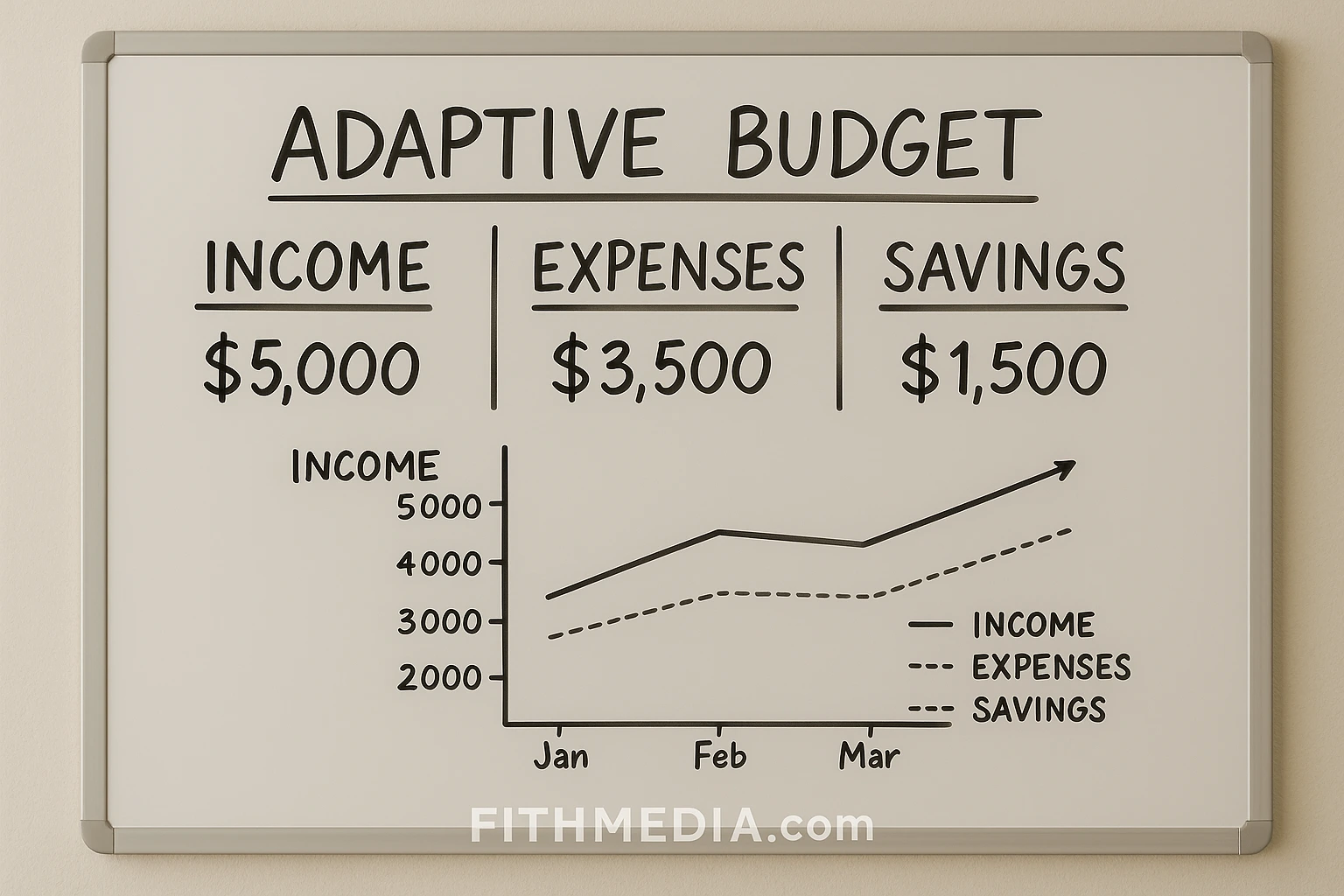
The Adaptive Spending Model — Budgeting for an Unpredictable Economy
Traditional budgets fail because they assume stable income and fixed prices—two luxuries Americans no longer have. The Adaptive Spending Model (ASM) is built for flux: it floats with your cash-flow and cost cycles.
Step 1: Calculate Your Essentials Base (E-Base)
List the true monthly cost to run your life without frills: housing, utilities, transportation, food, insurance, minimum debt payments. Add 10 percent for price creep. This is your E-Base — the amount that must always be covered first.
Step 2: Build a Flex Layer
Next comes Flex: discretionary spending that adjusts month to month ( dining, entertainment, shopping, subscriptions ). Instead of a fixed number, set a percentage band (10–20 percent of net income). If income drops, Flex shrinks; if income spikes, save half the extra.
Step 3: Automate the Buffer
Every payday, divert 5–10 percent to a “volatility buffer” account—separate from the emergency fund. Use it only for temporary income gaps, not emergencies. It acts as shock absorber when projects delay or hours cut.
Step 4: Rename Accounts by Purpose
Behavioral finance research shows that labeling accounts triples follow-through. Rename:
-
“Six-Month Floor Fund”
-
“Freedom Investing Core”
-
“Future Home Down Payment”
-
“Joy Spending 2026”
When your bank dashboard reflects your goals, motivation becomes automatic.
Savings Resilience — Turning Cash into Confidence
The Two-Tier Safety System
Tier 1: Emergency fund (3–6 months essentials)
Tier 2: Volatility fund (1–2 months extras + gig gap protection)
Keep Tier 1 in FDIC-insured high-yield savings or T-Bills; Tier 2 in money-market funds with liquidity within 24 hours.
Why Savings Needs a Job Description
Money without purpose gets spent. Assign every dollar a mission: security, growth, freedom, or joy. That psychological structure creates discipline without deprivation.
Automation Is the Quiet Hero
Link direct deposit splits or use tools like Fidelity Spire or SoFi Vaults to route percentages automatically. Resilient households remove willpower from the equation.
Investing Resilience — Grow Without Guessing
Stay Invested, Stay Sane
Historical data shows that missing the 10 best days of the market each decade cuts returns in half. The resilient approach is to keep dollar-cost averaging through volatility and rebalance annually.
The One-Screen Portfolio
If your holdings don’t fit on one screen, simplify. A three-fund or target-date portfolio delivers global diversification and stress reduction.
Human Capital as Your Biggest Asset
Invest in skills that raise earning capacity 10–30 percent over five years: data literacy, AI tools, management certifications. These investments beat any ETF in risk-adjusted return.
Debt Resilience — Leverage Without Losing Sleep
Categorize Your Debts
-
Toxic: Credit cards, personal loans > 10 percent APR
-
Functional: Student loans < 6 percent APR with tax benefits
-
Strategic: Mortgage or business loans funding appreciating assets
Attack toxic first, maintain functional, and optimize strategic.
The “4× Rule” for Borrowing Decisions
Only take debt if the return you reasonably expect is 4× the interest cost. If you can’t quantify that, don’t borrow.
Negotiate and Refinance Like a Pro
Call creditors twice a year: “Can you review my rate based on payment history?” A 2-minute call can save hundreds annually. Resilience is built in phone calls, not miracles.
Income Resilience — Multiple Streams, Minimal Stress
Think Portfolio, Not Paycheck
A resilient earner treats income like investments: diversified, complementary, and low-correlation.
Example mix: primary job (70%), side skill (20%), dividends (5%), passive product (5%).
Microbusiness Momentum
Launch a 90-day experiment with one offer, one customer avatar, one clear value. No LLC needed to test proof of concept. Resilience comes from cash-flow optionality, not complex structures.
Protect the Golden Goose
Maintain health insurance and rest. Burnout is a financial risk factor. Your capacity to earn is the engine; treat it like capital equipment.
Community and Social Resilience
Quiet wealth builders don’t do it alone. They form micro-communities of accountability — family budget meetings, church finance circles, online groups like r/financialindependence. Mutual support builds discipline faster than apps do.
Volunteer skills or mentor a teen on credit and saving. Generosity multiplies motivation.
Tech Tools That Fortify Financial Resilience
Digital discipline doesn’t replace habits; it amplifies them. Set alerts once and focus on life.
The Health-Wealth Connection
Stress spending is real. A 2025 APA study found 62 percent of Americans made impulsive purchases under stress. Resilient money habits start with self-care: sleep, movement, nutrition. When your body is stable, your budget is sane.
Estate and Protection Planning — Future-Proofing the Quiet Way
-
Update beneficiaries on every account annually.
-
Draft a simple will and health proxy using low-cost services like Trust & Will.
-
Create a digital vault with passwords and instructions for family.
This is not morbid; it’s merciful. Resilience includes those you love.
Recommended Reading
-
🔄 The November Reset: Why This Month Is Perfect for a Full Money Audit
-
💰 The Quiet Millionaire: How Everyday Americans Build Wealth Without the Spotlight →
-
🏡Financial Resilience 2026: Practical Money Resilience Habits for Americans
-
🌱 Financial Freedom 2025: The New American Dream Beyond Hustle Culture